What Breaks Next · November 13, 2026
What Is BGP? The Internet’s Road Signs, Explained
The internet runs on a 1989 protocol most executives have never heard of. It works on trust, and when one network posts a wrong sign, everyone else follows it. Here’s how BGP works, how it fails, and what to ask before you connect agents to critical systems.
By Megan Dahlgren
When something breaks online, people look at the application: Outlook, Teams, the website. Almost nobody looks at the layer underneath, the one that decides how traffic gets from one place to another. For most executives, that layer is invisible. It has a name: the Border Gateway Protocol, or BGP.
This is a short explainer for anyone who runs, buys or governs technology and has never had a reason to learn it. If you’re connecting AI agents to the systems your business runs on, now you do.
The internet is a network of networks
The internet isn’t one network. It’s tens of thousands of separate networks, run by carriers, cloud providers, universities, governments and companies. Each controls its own piece. None controls the whole.
For traffic to cross from your company to a website, it has to pass through several of these networks. Each one needs to know which way to send it next.
BGP is the road signs
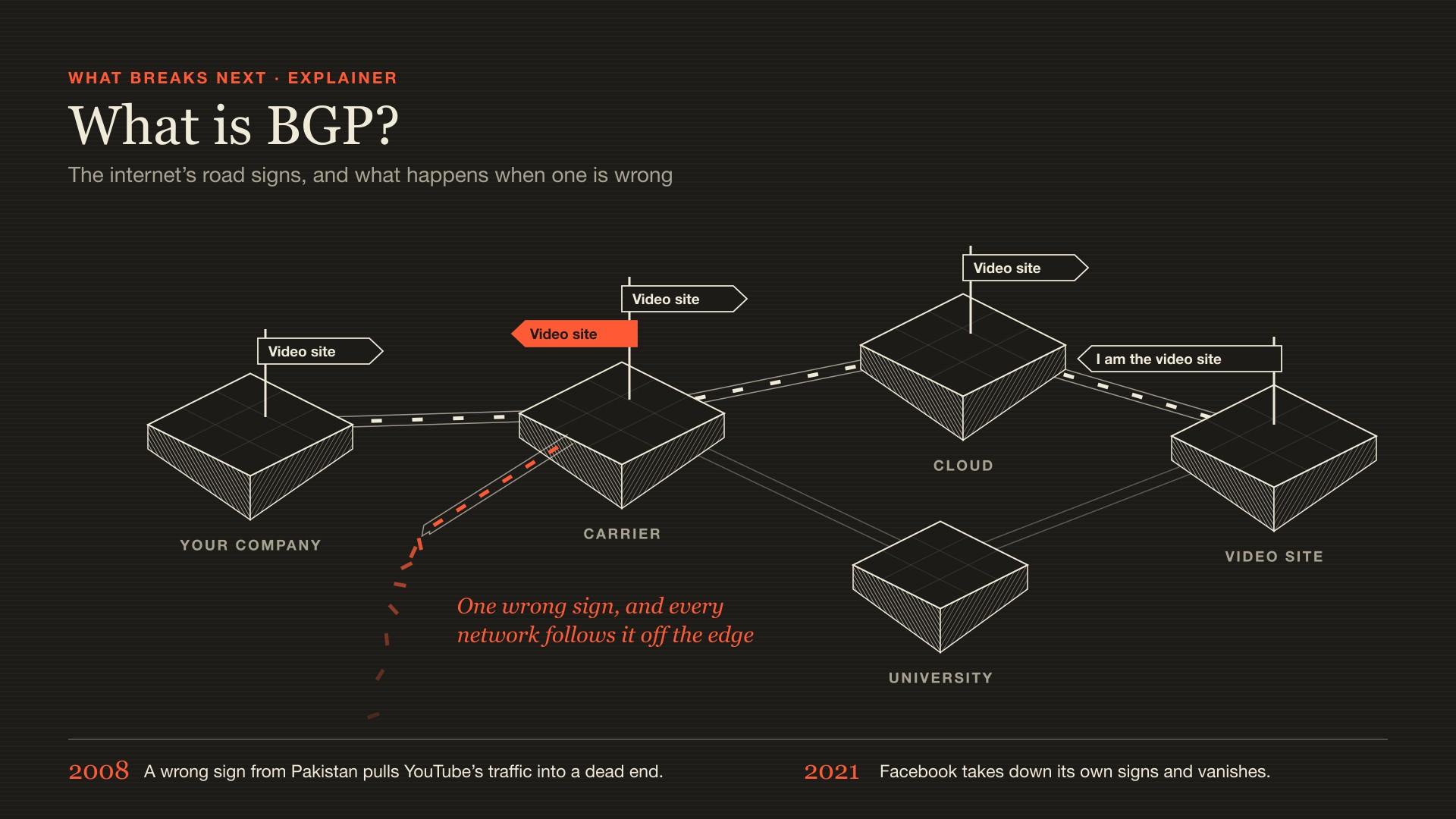
BGP is how networks tell each other where things are. Each network announces the addresses it can reach, like a sign that says “the video site, this way.” Its neighbors read the sign, post their own copy and pass it on. Within minutes, every network on the internet has a set of signs pointing toward every destination.
The key detail is that every network trusts the signs its neighbors post. There is no central authority checking them as they spread. If a sign says the video site is this way, traffic goes this way.
Built for a smaller, friendlier internet
BGP was designed in 1989, when the internet connected a small community of research institutions that largely knew and trusted each other. It worked, and it scaled far beyond what anyone imagined. But its trust model never really changed.
That means one wrong sign, posted by mistake or on purpose, can send traffic the wrong way or nowhere at all. And because every other network believes it, the mistake spreads.
When the signs go wrong
In February 2008, Pakistan Telecom was ordered to block YouTube inside Pakistan. It did so by posting a sign claiming to be the best route to YouTube. The sign was only meant for its own customers, but it leaked to an international provider, and from there to the world. For about two hours, much of the world’s YouTube traffic was pulled into Pakistan and dropped.
In October 2021, a command run during routine maintenance cut Facebook’s backbone off from its data centers. Facebook’s own systems then took down the signs pointing to its servers. Facebook, Instagram and WhatsApp disappeared from the internet for about six hours, and engineers struggled to reach the systems they needed to fix it.
The same weakness can be used deliberately. In 2018, attackers posted false signs for part of Amazon’s DNS service and redirected users of a cryptocurrency wallet site to a fake copy, where they stole funds.
Three incidents, three causes: a government order, an internal mistake, a criminal attack. The outcome was the same each time. Traffic went where the signs said, because that is how the system is built.
What’s being done about it
The industry has a fix for part of the problem. RPKI, short for Resource Public Key Infrastructure, lets the rightful owner of a block of addresses sign a certificate saying who may announce it, so other networks can reject a sign that doesn’t match. Adoption has grown steadily, but it isn’t universal, and it doesn’t catch every kind of mistake.
Other approaches go further. Identity-based overlays like Tailscale and noBGP (disclosure: I advise noBGP) connect systems by verified cryptographic identity, so a connection doesn’t depend on trusting the road signs at all. SCION, a next-generation routing architecture already used in Swiss financial networks, lets the sender choose the path and keeps failures contained.
Why this matters for AI agents
Enterprises are connecting their own agents to Microsoft 365, SAP, ServiceNow and Salesforce. Most of those connections travel over the public internet, guided by BGP. An agent that can’t reach its system of record stops working. An agent whose traffic is quietly redirected may be talking to someone else entirely.
Networking is the layer furthest from how most software teams think, which is exactly why it needs an owner before agents go live. Questions to ask:
Who owns the network path between our agents and the systems they depend on?
Do we have more than one path, and have we tested what happens when one disappears?
Do our network and cloud providers validate routes with RPKI?
Do our most critical connections depend on trusting the road signs, or on verified identity?
BGP isn’t going away, any more than the monoliths it connects us to. The goal is to design so that one wrong sign can’t take your business off the edge with it.
Read next
The Microsoft 365 Outage Is an Architecture Story →