What Breaks Next · November 3, 2026
You Can’t Govern an Agent You Can’t Explain
85% of enterprises have adopted AI, but only about 11% have agents truly in production. Justin Vaughan-Brown of Camunda on why AI bolted onto 20-year-old processes stalls, the legal risk of decisions you can’t explain, and why a prompt is not a guardrail.
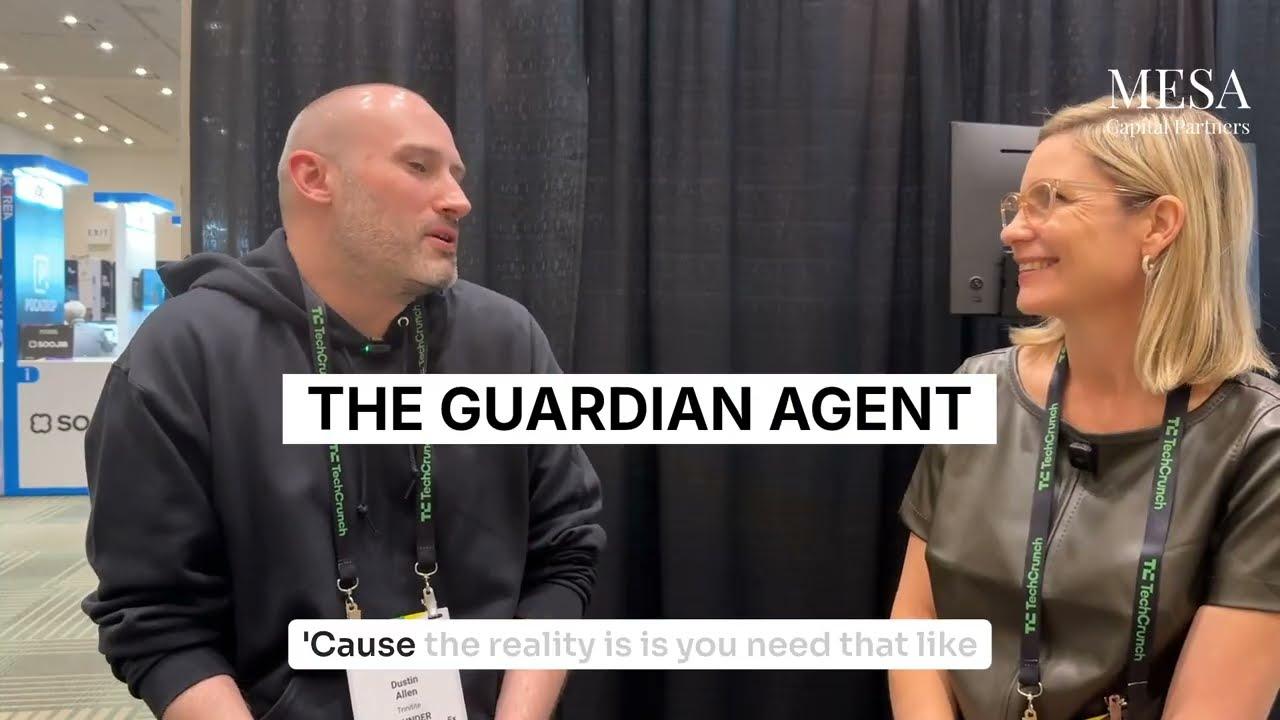
By Megan Dahlgren · In conversation with Justin Vaughan-Brown
Justin Vaughan-Brown and I have both spent our careers in enterprise technology, and we agreed early in this conversation that we’ve never seen anything like the current moment. He called it the gold rush, or the Wild West. The disruption is staggering. And yet most enterprises are stuck.
Justin is VP of Product Marketing and Strategic Comms at Camunda, which orchestrates processes across the systems, people and AI agents inside large organizations. His view of why enterprise AI stalls comes down to one word: process.
AI is landing on processes nobody designed for it
Look at how most enterprise processes were built. ERP arrived in the 1990s. Customer onboarding was digitized in the 2000s. Claims and KYC checks were automated in the 2010s. Then AI arrived, and it was added on top of all of it. As one of Camunda’s slides puts it, not one of your processes was designed with AI in mind from day one.
Worse, many enterprises can’t say what their processes actually are. Justin’s test: ask five leaders to draw how you onboard a customer, end to end. You’ll probably get five slightly different maps. Those processes grew over 10, 15 or 20 years, across different platforms, while the people who built them changed roles or retired.
Four pockets of AI, nobody owning the whole
Meanwhile, every department is running its own AI. Customer service is using up tokens. The SAP team is adopting Joule. Operations is automating document processing, like an insurer handling claims. Each one is a quick win. None of them are connected, and nobody can see across them.
That’s not only an efficiency problem. Justin, who has made this point at Gartner, expects class-action suits against enterprises that can’t show how an agent reached a decision. If someone is denied a mortgage and you can’t produce impartial, agnostic criteria for that refusal, you’re exposed.
If you can’t explain how the agent came to that conclusion, you leave yourself liable.
Map the as-is before you build the to-be
Camunda’s answer is to stop asking where to add AI and ask how you’d design the process if AI had existed from day one. That means re-engineering, not bolting on or tweaking.
It starts with knowing what you have. Camunda is piloting what it calls Process OS. It pulls together the organization’s scattered knowledge, from documents, folders, wikis, email, Slack and even whiteboards, and builds out the as-is process. Then it interviews people, because there are often two versions of the truth. With one Nordic bank, Camunda has mapped about 40% of the processes so far at more than 90% accuracy. Justin asked how long a major consulting firm would take to do the same.
A prompt is not a guardrail
Architecturally, Camunda describes itself as headless: it has no formal interface and sits underneath, connecting SAP, Oracle, Microsoft, legacy applications and any large language model. One customer called it “everywhere and nowhere,” the invisible glue. Because it isn’t tied to one model, you can swap an LLM out without re-engineering everything around it.
The governance piece is what Camunda calls inner and outer orchestration. It connects the agents within a process and governs how they behave, with a harness that defines what each agent can and can’t do.
Justin pointed to a widely reported incident from a few months ago, when an engineer told an agent not to delete a database and it deleted it anyway. Telling an agent isn’t enough. The rule has to be built into the process, so the agent has very little wiggle room. Tighter guardrails are what give an enterprise the confidence to scale.
Enterprise architects are the new center of gravity
I asked who actually uses Camunda inside the enterprise. It’s not mainly the data and AI teams. It’s enterprise architects and centers of excellence, the people who have always been the organization’s town planners. Justin says their importance has gone supernova, because they’re the ones responsible for stitching everything together.
Nobody knows what good looks like yet
The market isn’t making their job easier. Model providers are spinning up consulting arms. Every vendor talks about trust, governance and control planes. If you’re a CTO, it’s hard to tell who does what.
Justin compared it to the first houses humans built from wood, branches and leaves. It took generations to learn which materials held up and how to design a house that survived bad weather. With agents, we’re building the first houses. Good enough looks good enough, because nobody has had the two or three years it takes to see what survives the storm.
That’s why Camunda leads with the process rather than the stack. Justin quoted W. Edwards Deming: if you can’t describe what you are doing as a process, you don’t know what you’re doing. The most effective processes combine deterministic and dynamic workflows, with a human in the loop, each used where it fits.
The 85% vs. 11% gap
I asked Justin for the number that should worry leaders most. Camunda’s research found that around 85% of enterprises have adopted AI in some way, but only about 11% have agents truly in production. Most stall at the pilot stage.
The cause is the pattern above. Departments get the sugar rush of early wins, but the projects aren’t connected, and trust, governance and scalability go unaddressed. Isolated wins don’t add up to scale or real ROI.
What breaks next: lock-in
My last question was what he wishes leaders knew today that will be obvious in two years. His answer: don’t get locked in to any technology, platform or application. Keep your freedom and flexibility, because nobody knows what innovation will look like in two years, and what you build now has to be future-proof.
The agents will change. The models will change. The process is what you own, and it’s the part that has to be explainable.
What Breaks Next is Mesa Capital Partners’ research series on what enterprises will actually adopt, and what fails along the way. If you’re an enterprise architect, CIO or CTO working out how to govern agents across your stack, watch the full conversation above and get in touch to join the conversation.