What Breaks Next · November 9, 2026
Block AI and You Get Bypassed
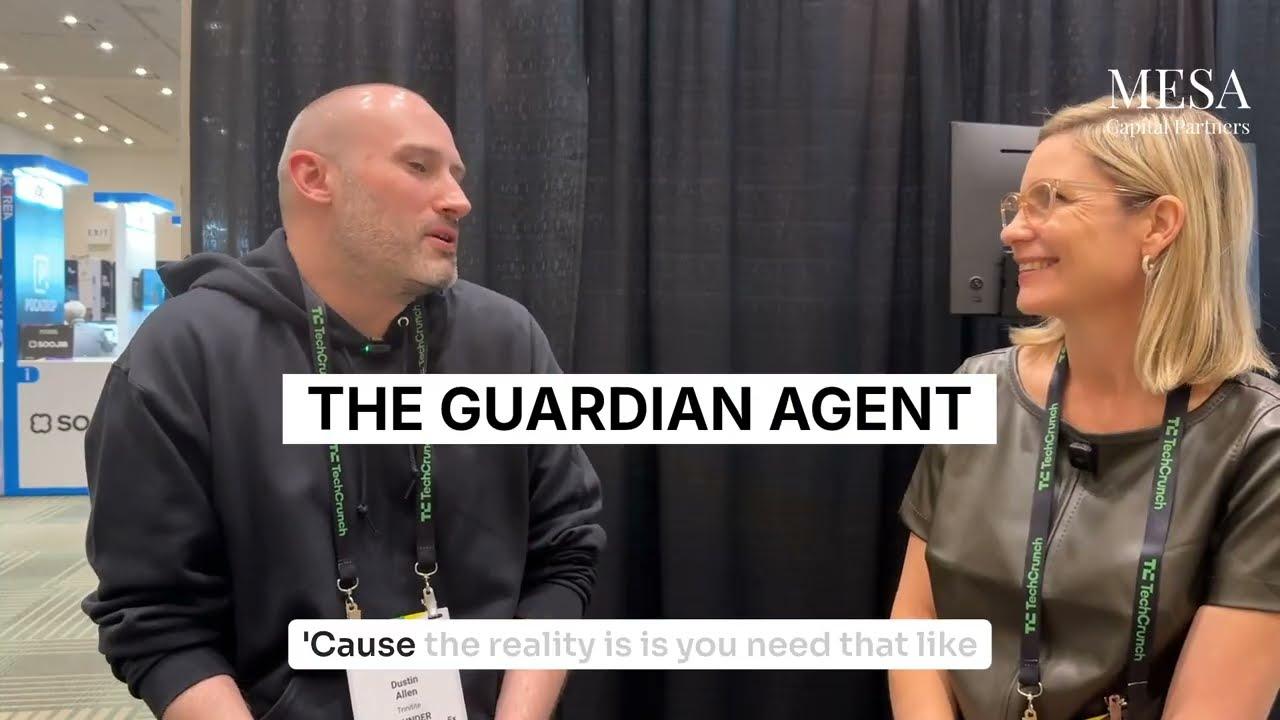
The business wants to go faster with AI. Security wants to know the risks. Alastair Paterson, CEO of Harmonic Security, on why harsh blocks fail, why AI governance isn’t next-gen endpoint security, and why this is the CISO’s moment to take a seat at the table.
By Megan Dahlgren · In conversation with Alastair Paterson
Every enterprise I talk to has the same argument going on inside it. The business says: let’s go faster with AI, get the tools rolled out, get employees enabled. Security, legal and compliance say: what are the risks, and where’s the governance?
Alastair Paterson, CEO and co-founder of Harmonic Security, put the dilemma plainly. If security tries to block everything, it gets bypassed, and it won’t be very popular. If it’s a free-for-all, it’s an unmanaged risk. Harmonic exists to get companies out of that trap: to make it safe and fast to roll out AI to the workforce.
The risk surface keeps moving
Alastair walked through how the problem has shifted. It started in the browser, with employees pasting corporate data into ChatGPT, Claude, Perplexity, personal accounts and China-hosted apps like DeepSeek. Then it moved to the endpoint, as engineers rolled out coding tools that kick off agentic workflows over MCP and move company data around programmatically.
Now knowledge work is back at the center. With cowork tools like Claude Cowork and ChatGPT, employees are connecting their CRM to their email and running autonomous agents on top through scheduled tasks. Agent builder software acts on the same data sources. There’s a lot of risk in that. But, as Alastair said, blocking it is the wrong answer too.
Coach, don’t block
Harmonic sits across all of those channels at once: the browser, the endpoint, and both local and remote MCP connections. It risk-assesses every AI interaction between an employee and an AI, including the agents employees deploy on their own behalf, and steps in automatically when something risky happens.
The interesting part is how it steps in. Harmonic has built about 40 small language models in-house that coach and nudge employees toward safe outcomes instead of just blocking them. Harsh blocks, Alastair argued, aren’t proportionate to the risk. They just push behavior around the edges. A flexible approach governs what you care about and still lets employees get real value out of AI.
Just harsh blocks aren’t going to work here. You push behavior around the edges.
Not next-gen endpoint security
I asked whether this is next-generation endpoint security. His answer was an immediate no. Endpoint is part of it, but governing AI means being in the browser, in the APIs, in the connectors around AI applications and in the agent builder software. Endpoint vendors call their version AI detection and response. Alastair sees a much broader question: how do you roll out a successful AI program that follows your policy and drives real business results?
That’s also why Harmonic positions itself as a partner, not a replacement. Its customers already run CrowdStrike, SentinelOne or Microsoft on the endpoint, often with Purview, plus an identity provider like Okta, Microsoft Entra or Google, and SASE gateways like Zscaler, Netskope or Palo Alto. Harmonic integrates with them. “We’re not trying to displace CrowdStrike off the endpoint,” he said.
Harmonic now has more than 100 major enterprise customers, including Fortune 50 companies and the largest healthcare company in the US. One of the Fortune 5 tech companies is rolling it out to hundreds of thousands of employees.
When the roadmap is one month long
The bigger vendors are moving closer through product updates and acquisitions. Alastair’s view is that it doesn’t matter much, because there’s no static product you can buy today that will solve this problem in six months. At the start of this year, MCP was still very early. The connector infrastructure barely existed. Scheduled tasks didn’t exist, let alone agents spun up by employees.
He mentioned hearing recently that the Claude Cowork roadmap is only one month long. If that’s the pace, how can any security provider run a year-long roadmap and keep up? Harmonic’s answer is to build the company like a flywheel that adjusts to the market and ships faster than the large incumbents can. Customers, he said, are buying into the journey as much as the product.
The CISO’s seat at the table
Almost every enterprise is having an internal conversation about who owns AI. Alastair sees a lot of AI steering committees, and who chairs them varies. Sometimes it’s the CISO.
That’s an opening. Security leaders always wanted a seat at the table, and this is the time to take it. Some get that. They’re becoming savvy about AI and how to enable it, and they see it as a career-defining moment. Others wish it would all go away and want to turn it all off. New roles keep appearing, including heads of AI, so Harmonic now works with CIOs, CTOs and AI leaders as well as security teams.
Seeing who’s enabled, and who isn’t
Once the tools are rolled out, the questions change. Who’s actually enabled? Where’s the value coming from in all that token spend? Harmonic’s newer product, usage intelligence, pulls together AI interactions across the browser, endpoint, agentic tooling and APIs, and surfaces the use cases employees actually have.
Different stakeholders read that differently. For compliance, it might be your obligations under the EU AI Act around using AI to screen CVs. Without visibility, Alastair said, you probably have a policy and are hoping for the best. For a CIO or head of AI, it might be this: the New York team is well enabled and using the Claude setup and skills you built, but the London team isn’t. Maybe London is using personal Perplexity accounts for the same work. Maybe they were never enabled. Or maybe that unsanctioned use is really valuable, and you’d better get an enterprise license around it before there’s a problem. Today, all of that is invisible.
Let a thousand flowers bloom
Across his customers, Alastair sees the same pattern. Bottom-up innovation is more powerful than the C-suite telling people to use a tool and be innovative. Every executive is trying to reinvent themselves as an AI evangelist. The ones who earn that reputation do it by letting the grassroots experiment safely, seeing what works and then scaling it up.
You want to let a thousand flowers bloom.
What breaks next: the CISO who says no
My last question was what he’d say to two CISOs: the one who’s embracing AI and the one who wishes it would go away. His answer was the same for both. Embrace it. It’s not going away, and if you don’t engage with the business on AI, they’ll go around you.
He pointed out how much the room has changed. A few years ago, a security leader who started talking about their DLP program and data labeling got ushered out as fast as possible. Box ticked, compliance done. Today, a security leader who walks in and says “here’s how I’m going to enable the company with AI, safely” has everyone’s attention, because everyone wants to move fast.
That’s the shift. The security team that blocks AI will be bypassed. The one that enables it safely gets the seat at the table it always wanted.
What Breaks Next is Mesa Capital Partners’ research series on what enterprises will actually adopt, and what fails along the way. If you’re a CISO, CIO or head of AI working out how to roll AI out across your workforce without losing control, watch the full conversation above and get in touch to join the conversation.